

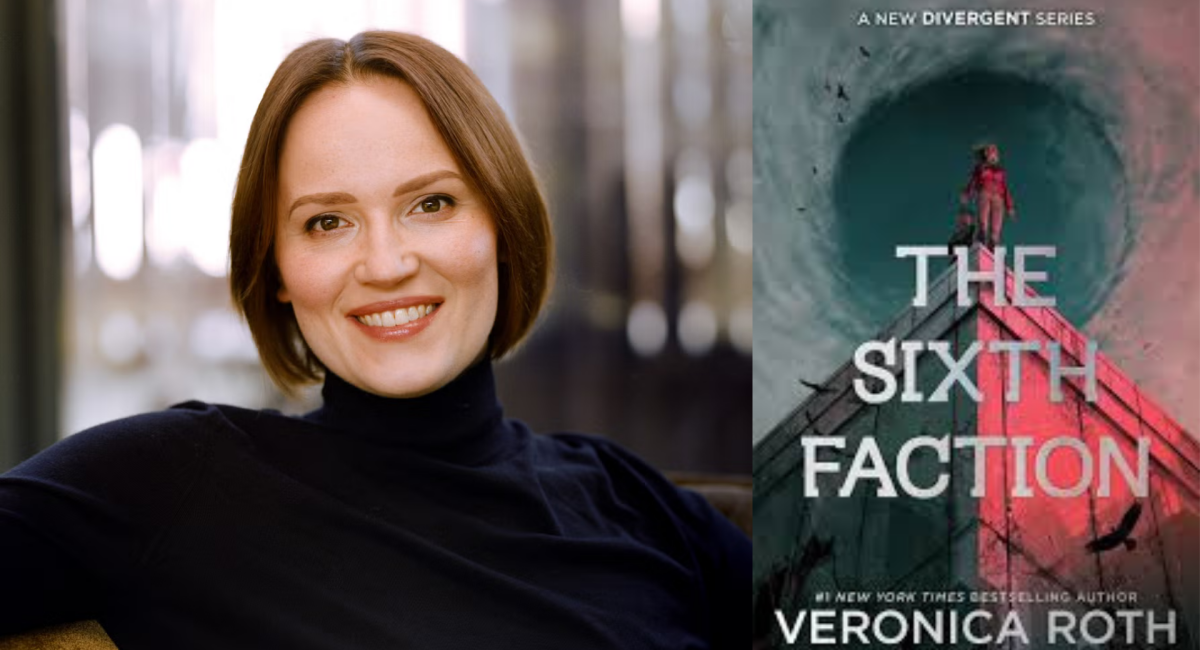
On Jan. 13, 2026, Veronica Roth published a newsletter entitled “Do I Like It? Reflecting on Divergent After 15 Years,” in which she addresses just how she feels about her bestselling Divergent series. Despite selling over 32 million copies worldwide and launching a series of film adaptations, the negative reception often rings loudest. The series ending is divisive among fans, and as Roth aptly says on Substack, “Your brain is good at keeping you safe by storing negative experiences.”
And despite publishing 10 books outside of the series, readers still come back to Divergent, with Roth saying in her newsletter: “And the people who hated Divergent? They really hated it, and often go out of their way to tell me why…whenever I try to talk about any new work. Or old work. Or any work.”
Yet, the author has not ceased writing. Seek the Traitor’s Son, the first book in a new romantic dystopian fantasy series by Roth, is coming May 12, 2026. But maybe more surprisingly, it’s not the only series Roth has coming this year because on Oct. 6, 2026, the Divergent series continues with The Sixth Faction, the first in a new duology.
At BookCon 2026, Roth announced the series to her fandom after keeping the long-held secret. But it’s neither a sequel nor a prequel to her original series; instead, it’s an alternate universe in which the heroine, Beatrice Prior, makes a different choice at her Choosing Ceremony.
We had the chance to sit down with Roth at BookCon 2026 to hear about her new fantasy series and just how she feels about Divergent with the announcement of The Sixth Faction.
Samantha Mangino: How are you feeling about the 15th anniversary of Divergent?
Veronica Roth: I feel good about it. Writing [The Sixth Faction] books, because they’re both done, really did help me to like feel more positively about the series. It doesn’t like bother me as much when people talk to me about Divergent because I don’t feel like I’m stuck in the past, because I’m writing something new, so it feels like we’re talking about what I’m doing now instead of what I was doing when I was 24, which is more restorative, regenerative, and exciting for a creative person.
SM: You’re very matter-of-fact when talking about your writing. Do you think that’s something that’s just come with time and being able to look back?
Mashable Trend Report
VR: I think this is honestly just how I am. I’ve got a Polish mother, and I live in the Midwest, so I think we’re just really straightforward people. It doesn’t cost me anything, and so I do it. I’m a terrible liar.
SM: Do you feel like this post-Divergent mindset led you to being able to write Seek the Traitor’s Son? Or was it something that felt like a natural progression?
VR: I worked on Seek the Traitor’s Son over the course of five years and 10 drafts. It was just a joyful project for me. It’s full of everything that I love, and I also learned important lessons from it, about keeping stories intimate, even though the backdrop is big and epic. And you know I couldn’t have written The Sixth Faction without that because I needed to be able to not think about all the things that Divergent is, and just focus on the story and the characters that I love. So Seek the Traitor’s Son taught me how to do that.
SM: Divergent is a massively popular and widely beloved thing, but I think it also falls into opinionated internet conversations. I’m curious, how that has felt like it’s affected your writing generally?
VR: I think it has been a challenge to navigate because it’s a lot of negativity, even though it’s also a lot of positivity. And as I’ve discussed, I’m much better at retaining negativity than positivity. That’s just how my brain works. What I’ve been able to do is create a safe space for myself in my writing. I think with the process of writing Seek the Traitor’s Son, that’s kinda what I was doing because it wasn’t for anyone else. It was a healing book.
SM: Do you have to set boundaries with yourself in online spaces to stay in a clear mindset while writing?
VR: I have rules, so if someone’s mean to me, I block them. I set up filters, sometimes I have to filter myself because the algorithm is like, ‘you might be interested in this,’ but, no, I’m not — I don’t wanna see that. I don’t make anyone else responsible for my emotional well-being — that’s my other rule. But it is fun to engage with readers, so you wanna talk to them and answer their questions and joke around with them. It’s just a bunch of people talking about books; we all love books.
SM: I’m wondering if you’ve noticed a change in internet spaces now compared to when you published Divergent in 2011?
VR: I think it feels pretty much the same, but the platforms are different. My real thought about it is that it is my responsibility to develop a sufficient amount of resilience. To deal with some negativity, because that is the nature of being a public person. It was the nature of my sister working in a J. Crew. As an adult, everyone is required to tolerate some people being unkind to you — that’s existing in the world. But you’re also allowed to defend yourself and to separate yourself from things that are toxic. So I try and balance those two things. I can’t control people. I can only control me.
SM: After taking a break from Divergent, do you feel like you’re carrying any new wisdom into The Sixth Faction?
VR: Stories about young people have changed because the world has changed. So in this book, Tris is a little less of, ‘I will save the world on my own,’ and a little more of a 16-year-old navigating a very difficult sociopolitical situation that she is not prepared for. And that just feels like the reality of being a teenager right now, and I wanted the story to speak to that. When you get a little bit more life under your belt, as a person and as a writer, you’re able to approach the series with a new perspective.

Other Articles

Coinbase Lobbying Hit $1.07M in Q1 on Crypto Laws



No Comment! Be the first one.