

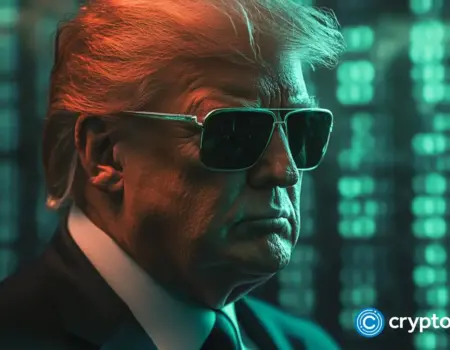
Eric Trump said Justin Sun’s lawsuit against World Liberty Financial is “ridiculous,” but not as ridiculous as the $6 million the TRON founder once spent on Maurizio Cattelan’s banana duct-taped to a wall.
The only thing more ridiculous than this lawsuit is spending $6 million on a banana duct-taped to a wall. We are incredibly proud of the @worldlibertyfi team… https://t.co/ahfBKvCdwN
— Eric Trump (@EricTrump) April 22, 2026
The Trump son, who co-founded the DeFi project that is facing backlash over its governance and a controversial $75 million loan, mocked Sun and his iconic move after the entrepreneur said he had filed a federal lawsuit against the firm.
The suit alleges that World Liberty wrongfully froze his WLFI tokens and stripped him of governance rights through an opaque blacklist mechanism that he says undermines decentralization and transparency.
The two were publicly close. Trump previously called Sun “a great friend” and said he was TRON’s “biggest fan.”
In a statement responding to Sun’s legal action, Zach Witkoff, co‑founder and CEO of World Liberty, said he expects the lawsuit to be thrown out.
Witkoff described the case as a meritless attempt to deflect from alleged misconduct and reaffirmed that the firm’s actions were taken to protect users.
Justin Sun’s recent lawsuit against @worldlibertyfi is a desperate attempt to deflect attention from Sun’s own misconduct. His claims are entirely meritless, and World Liberty looks forward to getting the case thrown out promptly.
He engaged in misconduct that required World…
— Zach Witkoff (@ZachWitkoff) April 22, 2026
Token concentration and family earnings
Data shows just 10 wallets control roughly 76% of WLFI’s voting power. The Trump family holds an estimated 22.5 billion WLFI tokens and reportedly controls about 60% ownership of the venture.
By December 2025, the family had reportedly earned $1 billion from the project.
Sun was WLFI’s largest outside investor, putting $75 million into the project. The trouble started in September 2025, when the WLFI team blacklisted his wallet and froze approximately 540 million unlocked tokens.
The stated reason was that on-chain transfers of around $9 million in WLFI to exchanges looked like early selling. Sun maintained the transfers were minor test transactions.
The governance proposal
On April 15, 2026, World Liberty published a governance proposal affecting over 62 billion tokens. Under the proposal, holders who don’t “affirmatively accept” the new terms, including mandatory burns of 10% of advisor tokens, would have their holdings locked indefinitely.
Early purchaser tokens would face a two-year cliff followed by two years of vesting. Holders who don’t opt in would have their tokens frozen in perpetuity. Sun, whose tokens were already frozen, couldn’t even vote on it.
WLFI hit $0.46 in September 2025, around the time Sun’s wallet was first blacklisted. By April 2026, it had fallen to an all-time low near $0.076, a decline of more than 83%.
The token changed hands at $0.08 at press time, per CoinGecko.
The blacklist function
Sun’s legal filing also points to what he calls a concealed blacklist function embedded in WLFI’s smart contracts. This mechanism allegedly allows the project team to freeze or restrict any token holder’s assets without notifying the holder.
The TRON founder said that undermines the project’s claims of decentralization, transparency, and fair governance, and violates the core principles of user control in DeFi systems.
Sun, whose net worth is estimated at $10.9 billion by Bloomberg Billionaires Index, said he tried in good faith to resolve the situation without litigation.






No Comment! Be the first one.