

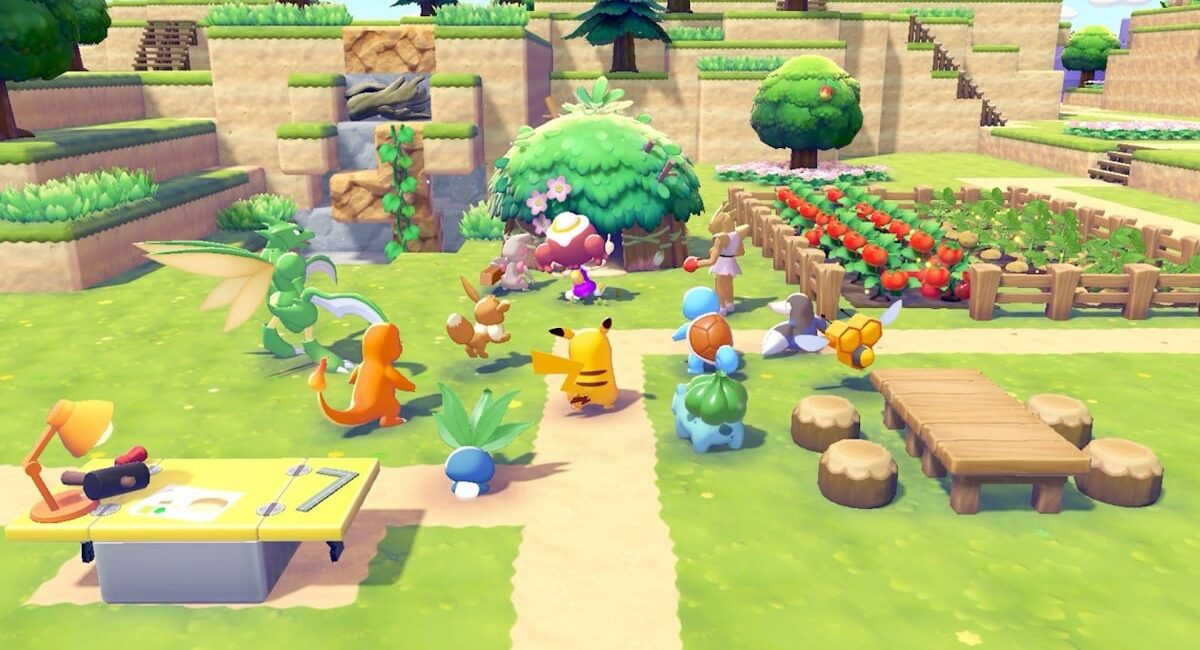
You can find plenty of doom-and-gloom takes about the Nintendo Switch 2. Many of them boil down to complaints about the lack of compelling exclusive games for the system.
The users making these complaints, however, have not yet played Pokémon Pokopia.
A combined effort from Nintendo, The Pokémon Company, Game Freak, and Koei Tecmo, Pokémon Pokopia launches exclusively on Switch 2 on March 5. More importantly, you may not be prepared for how big of a deal this game might be.
Credit: The Pokémon Company
Essentially, the Nintendo team took Minecraft, stripped off the ugly art style, added social friendship mechanics a la Stardew Valley, and put a bunch of Pokémon in it.
Personally, I do not vibe with these types of games at all. But Pokopia combines player creativity, charming writing, a magnetic sense of progression that makes it hard to put down, and a downright shocking level of depth. It legitimately has me hooked. I want to keep digging away at Pokopia just to see what it has to offer, and it hasn’t disappointed me yet.
I just want to pick up Pokémon Pokopia and give it a hug

Yep, that’s what humans look like.
Credit: Nintendo
I covered the basics of Pokopia in a hands-on preview. But here’s the TL;DR. The easiest way to think of this game is that it takes elements of Minecraft, Animal Crossing, and Stardew Valley, all mixed in with an extremely potent dose of Pokémon creatures.
You start the game as a Ditto (a basic “normal” shapeshifting Pokémon) who wakes up in a world where all the humans are gone, leaving only ruined settlements. You take on the shape of a human (well, close enough) and set out to rebuild what once was, in the hope of attracting more Pokémon and eventually maybe some humans to come live with them.
Aesthetically, this means you play as a human child with a mildly creepy smiling Ditto face on it. Mechanically, this means all of your farming and town-building abilities include classic Pokémon moves such as Cut, Strength, and Surf, each learned from a different Pokémon and copied by the Ditto.

Bulbasaur is one of the best little guys we’ve got.
Credit: Nintendo
The best part of Pokopia is that each Pokémon who settles in your towns — you’ll actually build several across many different biomes as the game progresses — speaks your language and has a personality of its own. There’s no combat in Pokopia. You endear yourself to Pokémon by giving them gifts and building homes for them.
The writing in Pokopia is surprisingly funny; I was especially taken by a Magikarp who punctuates almost every sentence with the word “yo” for no good reason.
Mashable Top Stories
A big part of what makes Pokopia work for me, where games like Minecraft haven’t, is that you spend as much time talking to NPCs and trying to figure out how to solve their problems as you do digging through rocks and placing structures.
The game has a really nice amount of player direction, so there’s never any confusion as to what you can or should be doing at any point in time. Pokopia is also smart not to push the player too hard in any one direction. Even when you unlock new areas, the game explicitly encourages you to stick around the old ones and improve them before moving on.
The result is relaxing and peaceful, without ever really feeling like work.
But Pokopia also has so, so much more going on than you think

This is where I want to be at all times.
Credit: Nintendo
Having said that, there is a lot of work you can do in Pokopia. In the 10 to 15 hours I’ve played, I’ve been gobsmacked at the level of mechanical depth in this game. A lot of the things you can do are similar to activities in Minecraft and its many derivatives, but I expected a Pokémon-themed take on that kind of game to simplify things.
Pokopia does not dumb it down, however, and that’s a good thing.
For instance, bodies of water have rudimentary physics. You can dig out creeks if you feel like it. Grass on either side of a creek will benefit accordingly, so that’s a smart place to plant crops. Putting too much water in one area will increase its humidity, which might upset some Pokémon, but will please others. Yes, you can manage humidity in Pokémon Pokopia.
That’s not all. Windmills and water wheels can be used to power electrical appliances, and you can string together utility poles to power a whole town. Materials like clay can be turned into necessities like bricks if you happen to know a guy who can smelt them for you.
Pokémon like to have their own homes — but if you build a big enough one for yourself, you can invite your favorites to move in with you. I became roommates with Scyther at the earliest opportunity, because Scyther is cool as hell.

Welcome to Homie House.
Credit: Nintendo
Pokopia even has cooking mechanics, which I’ve barely touched because I’ve been so busy doing other stuff. And I haven’t even had a chance to try the online multiplayer, which enables groups of friends to turn blank landmasses into the Pokémon paradises of their dreams through collaborative construction projects.
Each step of the way, Pokémon Pokopia will introduce some wild new idea or mechanic, which turns out to be a great way to keep someone who isn’t especially keen on managing little towns invested in the proceedings.
In short, I am wildly impressed by what I’ve played of Pokémon Pokopia, and I’m not even the game’s target audience. It may be the best Pokémon spin-off I’ve ever played, and easily one of the best games in the whole series in a long time, even including the RPGs.
I can’t wait to see what people who get really into Pokopia do with its menagerie of systems once the game has been out for a few weeks.
Pokémon Pokopia launches exclusively on Nintendo Switch 2 on March 5.
Credit: The Pokémon Company







No Comment! Be the first one.