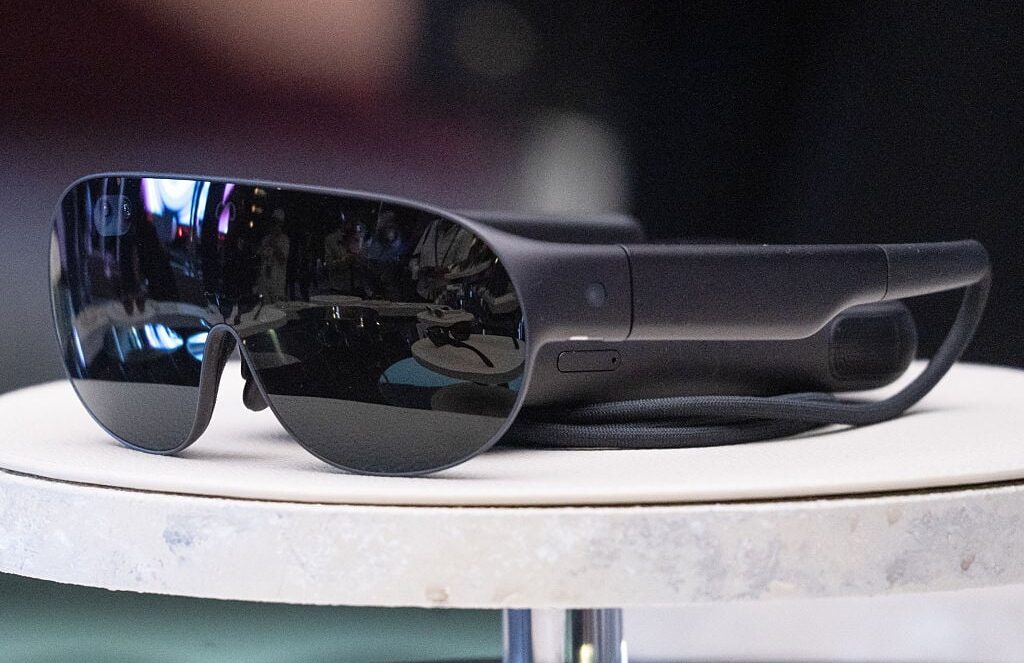


At Meta Connect on Wednesday night, Mark Zuckerberg unveiled what could be the next frontier of VR hardware for the company alternative: the Meta VR glasses.
These new specs blend the form factor of regular smart glasses with the stereoscopic 3D and virtual reality capabilities of a Quest headset. But how, exactly, do these glasses compare with the Quest 3? We can’t directly test the glasses just yet, but even on paper, there are some notable differences to consider.
Meta VR Glasses vs. Quest 3: Price
The most obvious difference between these two devices, aside from the way they look, is the price. The VR Glasses, when they launch in 2027, will start at $1,299. The Quest 3, meanwhile, can currently be had for just $599. One of these VR devices costs literally more than twice as much as the other, so set your expectations accordingly.
Meta VR Glasses vs. Quest 3: Specs

Credit: Meta
Despite the price difference, there are actually a couple of areas where the Quest 3 outperforms the VR Glasses on a specs level.
Here are the basic specs of the VR Glasses:
-
Display: Micro-OLED display with 2412×2288 resolution per eye
-
Field of view: 70 degrees by 66 degrees
-
Processor: Snapdragon Reality Elite
-
RAM: 12GB
-
Starting storage: 128GB
-
Controllers: Not included, but compatible
And here are the equivalent specs for the Quest 3:
-
Display: LCD display with 2064×2208 resolution per eye
-
Field of view: 110 degrees by 96 degrees
-
Processor: Snapdragon XR2 Gen 2
-
RAM: 8GB
-
Starting storage: 512GB
-
Controllers: Included
The VR Glasses have the Quest 3 beat on display resolution and RAM, as well as with a newer processor. But there are some areas in which the Quest 3 wins here, too. Its field of view is significantly larger, as you’d expect from something that completely covers your face. It also comes with significantly more starting storage and a pair of touch controllers. The VR Glasses have a microSD card slot for expandable storage, and the controllers are compatible, but not included.
Meta VR Glasses vs. Quest 3: Design

Credit: Kimberly Gedeon/Mashable
Well, this one’s simple. One device is a pair of glasses, and the other is a full-on headset. Whichever you prefer is ultimately a matter of taste.
There are pros and cons to each. The VR Glasses allow the user a greater degree of spatial awareness because they don’t cover as much of the face, but that might also make VR experiences less immersive. Meanwhile, the Quest 3 will probably be a bit more immersive, but it’s heavier and more cumbersome because its computing hardware sits in the headset.
That last part is important, as the VR Glasses don’t actually have any of the real computing hardware built into the glasses themselves. Instead, there’s a computing puck attached to the device by wire, similar to the Apple Vision Pro. That’s what allows the glasses to be as sleek as they are compared to the Quest 3, but it might also explain why the starting storage is so low in comparison.
Ultimately, the glasses weigh about 100 grams and the headset weighs 515 grams. That’s a big enough difference to justify the use of a puck, but again, it’s your call.
Meta VR Glasses vs. Quest 3: Software
There is some overlap in terms of available software features, but there are also some key differences between the VR Glasses and Quest 3. In general, it seems like the VR Glasses can do more.
Both devices run on the same operating system, and the glasses support all of the same related content term that is currently available on Quest 3. Things get more interesting when you look at what the VR Glasses can do that the Quest 3 can’t. The glasses support eye tracking and face tracking in addition to hand tracking, while the headset supports hand tracking but not eye or face tracking.
As such, there are some VR Glasses-centric gaming experiences, like a new update variation to Beat Saber that allows the game to be played without controllers. Glasses owners will also be able to watch fully 3D movies from streaming services like Disney+, and the glasses are the first VR device to be IMAX certified, according to Meta. Meta also envisions the glasses being used as a work device, so they can connect to Macs or PCs using USB-C or wirelessly. That will give users the ability to create virtual displays for their workspace.
Last but not least is Hologram, a new method of video calling coming first to the VR Glasses. You’ll be able to join WhatsApp video calls as a face-tracked avatar of yourself, appearing at true scale for the other participants. This feature won’t fully render everyone in 3D at launch, but Meta says that’s coming later. The metaverse is back, folks.
Given that the VR Glasses are newer and much more expensive, it’s not surprising that they seem broadly more capable than the Quest 3. But, as you can tell, there might still be reasons to get a Quest 3 instead.
Source: https://mashable.com/tech/meta-vr-glasses-vs-quest-3