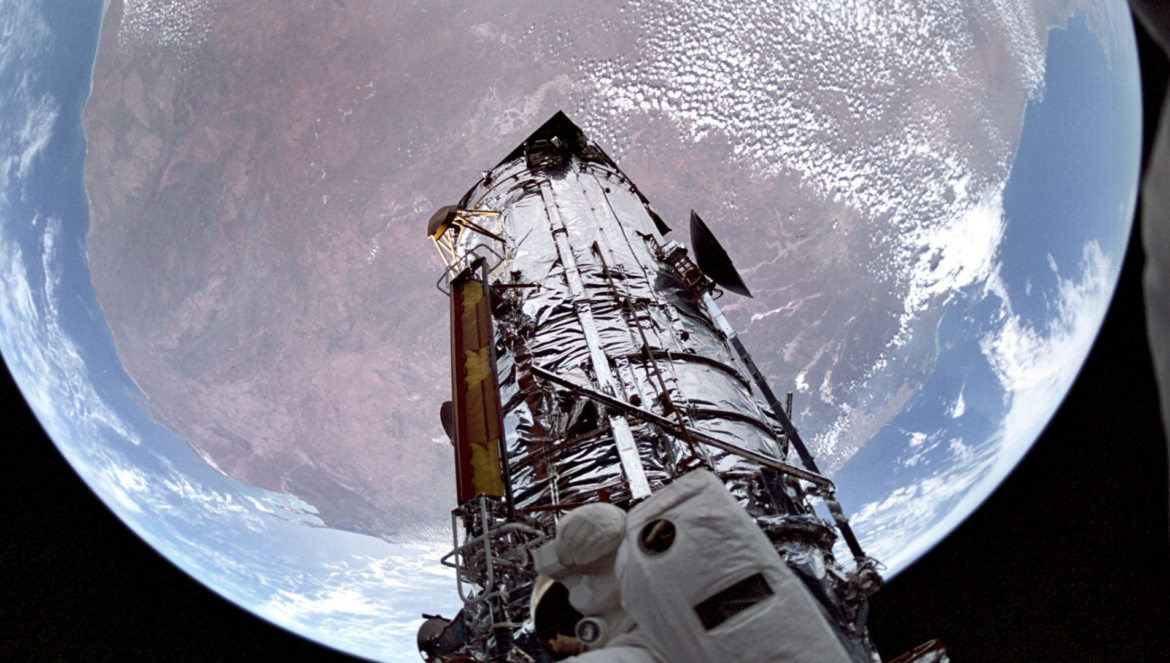


Sad news for space aficionados: the famous Hubble Space Telescope, responsible for some of the most jaw-dropping images of our solar system taken more than three decades since its launch into low-Earth orbit in 1990, is on a slow path towards a fiery fate. At its present rate of altitude loss, NASA’s most famous telescope is expected to re-enter Earth’s atmosphere sometime in 2033 or 2034, at which point it will come crashing down like a comet, according to Space.com, possibly endangering human life on its descent
It doesn’t have to be that way, though. If NASA had more room in its budget, it could repeat its 2002 Space Shuttle Columbia mission STS-109 and give the aging telescope a nudge into a higher orbit, extending its lifespan. In desperation, NASA has put out a Request for Information (RFI) to the fast-growing commercial space sector, hoping for aid to either boost Hubble’s altitude and extend its lifespan or else guide its descent to a safe crash site, such as the middle of the ocean.
According to the RFI, a successful orbital boost would require an ascent of more than 370 miles (600 kilometers), which is a significant increase in elevation and an astonishingly difficult challenge from a purely technical perspective.
In a statement variation on the NASA website, Nicky Fox, an associate administrator of the Science Mission Directorate, spoke to the growing power and influence of the private space sector: “Commercial industry alternative has rapidly evolved in recent years to offer new capabilities for in-space satellite capture and servicing. Given the time we have until Hubble’s anticipated re-entry, we are eager to explore the breadth of possibilities to boost Hubble to a higher orbit while we develop the flagship mission to follow.”
NASA administrator Jared Isaacman spoke of a duty to both “the American taxpayer” and “the scientific community” to explore all possible ways to extend Hubble’s life, and the project is likely to attract serious related interest term from companies like Elon Musk’s SpaceX and Peter Beck’s Rocket Lab, which became famous for successfully catching a used rocket with a helicopter.
It wouldn’t even be the first time that the commercial space sector has lent NASA a helping hand. In March of last year, stranded astronauts Suni Williams and Butch Wilmore were rescued from the International Space Station with assistance from SpaceX’s Dragon spacecraft.
Let’s hope history repeats itself and NASA finds a willing collaborator, because Hubble’s insights over more than a three decades have radically altered our understanding of the universe we inhabit and inspired new generations to look to the stars.
Source: https://mashable.com/science/nasa-reaches-out-to-commercial-space-industry-for-help-saving-legendary