

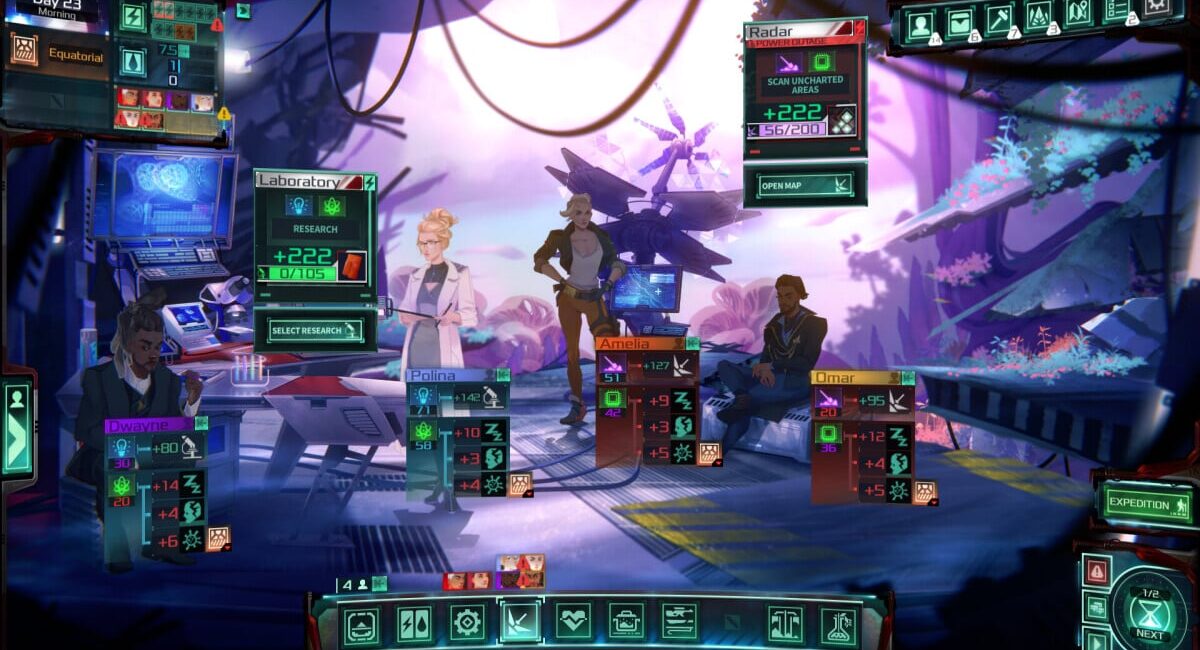
Humanity is enamoured with the idea of venturing out into the universe, seeing the stars and discovering literal worlds of opportunity beyond Earth. But do we deserve it? Developed by French indie studio Ishtar Games, Dead in Antares is a turn-based sci-fi survival management game that poses questions about the ethics of space exploration — or more specifically, space colonialism.
Dead in Antares follows the 10-member crew of the Ixion, a spaceship on a mission to find a power source which could solve the apocalyptic energy crisis back on Earth. Unfortunately, a wormhole throws the ship off course, ultimately crash-landing on the titular Antares. Alive yet stranded, the crew must work together not only to survive, but to return home with the key to saving humanity.
Having spent 42 hours with Dead in Antares, I’ve been happily absorbed with managing my ragtag interstellar outpost, assigning crew members to various daily tasks to ensure our continued survival and search for a way off the planet. However, as time has passed, I admit my zealous pursuit of a homecoming has waned.
Of course, I’d at least like to know that we’re capable of getting back to Earth. I’m not about to leave the rest of humanity to suffer and die, which is what I’m told will happen if our mission isn’t successful. Still, I’ll miss Antares when (or if) we end up leaving. I’m quite enjoying running our little camp, and feel as though we’ve hit a comfortable, sustainable rhythm.
I also don’t look forward to the difficult ethical choices I’ll have to make concerning both planets’ futures.
Trying not to be Dead in Antares

Credit: Mashable screenshot: Dead in Antares / Ishtar Games
Dead in Antares is the third title in Ishtar Games’ Dead In series, following 2018’s Dead in Vinland and 2015’s Dead in Bermuda. Even so, you don’t need to know anything about Dead in Antares‘ predecessors to enjoy the game. Each game is its own standalone title, taking place in completely different settings that merely share similar survival themes and mechanics.
In this case, Dead in Antares‘ engaging game loop has you manage each day on the eponymous alien planet. Players delegate crew members to tasks such as gathering water, hunting for food, generating power, and upgrading the camp, with jobs conducted across morning and evening shifts. A group of three can also use water rations to conduct daily expeditions, searching the surrounding area for resources and potentially engaging in turn-based battles with aliens. Everyone must then be fed and watered before going to bed, keeping them healthy enough to do it all again tomorrow.
Each crew member has different skills that impact how well they perform a given task, and which increase the more they’re used. Someone with a high Medicine skill will be more effective in the Infirmary, while a colleague with a low Stealth skill is more likely to encounter adversaries while on expeditions.
Your crewmates’ job performance can also be modified by any positive or negative traits they carry, as well as their needs. Fatigue, hunger, sickness, injury, and stress can reduce their effectiveness, or even kill them if levels reach 100, resulting in a game over.

Credit: Mashable screenshot: Dead in Antares / Ishtar Games
As such, Dead in Antares becomes a careful balance of managing the group’s needs and resources with your crewmates’ skills and wellbeing. Nurturing each individual’s proficiencies and optimising job allocations feels satisfying, maximising benefits for the smallest expenditure possible.
One might expect the struggle for survival to give Dead in Antares an inescapably grim tone, and story moments do provide dire reminders of what’s at stake back on Earth. Yet outside of this, the game often feels more like an exciting planetary adventure. Getting sick from eating alien bugs lightyears from home while burdened with saving humanity sounds like one of my most vivid stress dreams, but apparently the Ixion’s crew are less susceptible to crippling implosions of existential dread.
Instead, they largely respond to Antares’ strange and colourful extraterrestrial landscape with fascinated awe. Dead in Antares leans into the alien nature of the planet’s organisms, populating it with creatures that blend features of flora, fauna, and minerals so they can’t be clearly categorised. Among these lifeforms are two sentient, similarly-named alien races: the Atlanteans and Antarians. This is where space colonialism comes in.
Dead in Antares confronts the line between extraction and exploitation

Credit: Mashable screenshot: Dead in Antares / Ishtar Games
Humanity has a long history of travelling to foreign lands only to mercilessly exploit them, doing incalculable harm to the environment and its native inhabitants in the process. We also have a habit of repeating history, or at least ensuring it rhymes. There is no reason to expect this will change simply because we’ve traded in oceanic voyages for intergalactic ones.
While extracting resources from your surroundings is part and parcel of survival games, Dead in Antares takes this a step further by incorporating parallel themes into its plot. Humanity’s survival depends on the Ixion’s appropriating a new power source from Antares, which the planet’s inhabitants already rely upon. The question Dead in Antares poses is whether you are willing to exploit this unfamiliar planet you’ve landed on and cause its population to suffer. What are the consequences of doing so — or from refraining? How much do you actually care?
I initially aimed to keep out of the Atlanteans’ and Antarians’ business, choosing diplomatic dialogue options and paying the tributes demanded of me in order to keep the peace. I have no interest in attacking people in their homes and imposing my will upon them, or engaging in conflicts I don’t fully understand. Still, my attitude changed as I gathered further knowledge of the political situation on Antares, and as the burden of tributes grew too onerous.
The additional turn-based battles this sparked helped break up the everyday routine of job allocation, and I was glad to no longer surrender my lunch money to alien bullies. Yet as the days passed, I became increasingly aware that the peaceful resolution I’d initially hoped for may have never been an option. Dead in Antares‘ gameplay is fun, however its plot is imbued with an undercurrent of inescapable doom.
With such ethical quandaries hanging over you, I can’t say that Dead in Antares is likely to leave players feeling satisfied. There’s a sense that no truly happy ending is possible, and that someone will suffer no matter what you do. Even so, narrative satisfaction doesn’t appear to be Dead in Antares‘ goal. As in real life, while these problems must be confronted, they cannot be neatly solved.
Dead in Antares can be rough around the edges

Credit: Mashable screenshot: Dead in Antares / Ishtar Games
Dead in Antares is an enjoyable game with an interesting premise and creative setting, and almost all Ixion’s diverse crew members endeared themselves to me in various ways. Still, there are some aspects that would benefit from tweaks.
The game gives you a lot of information to manage, with all 10 crew members having varying skills, health statuses, traits, combat abilities, and relationships with each other. A notification will appear on the crew profile button whenever there’s an update to these, but you have to flip between everyone’s full-page profiles to actually see what’s changed. This is particularly annoying when, for example, half of your crew didn’t get enough water last night, resulting in five notifications that can only be cleared by beholding each individuals’ dehydration status in their Traits tab.
I quickly took to ignoring much of this data deluge, leaving notifications uncleared and only referencing my crew’s needs and skills when assigning jobs. Even so, I still found myself wishing for a complete overview screen of my crew comparing all their stats at once. There is a lefthand side bar which pops out to display a list of your companions, which can be sorted by how high a certain skill or need is, but you need to scroll to view everyone and it does nothing for clearing notifications.

Credit: Mashable screenshot: Dead in Antares / Ishtar Games
Dead in Antares also isn’t always clear on how to progress. I was held up for several in-game days before I figured out that I could craft the materials the main questline required instead of scavenging for them, but needed to first upgrade my workshop so I could build the forge. I hadn’t even realised that upgrading was an option, as it was given the same prominence as other less significant enhancements on its upgrade tree.
As such, I would have liked it if there was an overview page showing the upgrade trees for all the workstations, allowing players to bookmark what materials are required. As it is, Dead in Antares has me frequently swapping between menus to check which resources I needed to craft specific materials, which materials I needed to craft an upgrade, and which upgrade I needed to craft a new workstation.

Credit: Mashable screenshot: Dead in Antares / Ishtar Games
Another aspect that could be smoothed out is Dead in Antares‘ writing, as I often felt as though I was getting the gist of the plot rather than the plot itself. The game assumed knowledge without having even hinted at it previously, which frequently left me wondering if I’d somehow missed exposition. Major developments would sometimes not only occur offscreen, but had been apparently processed and acted upon.
Further, while Dead in Antares primarily follows Captain Amelia and has players make dialogue decisions as her from the outset, it later jumps between crew members’ points of view with little warning. This can even happen within a single scene. The result can be confusing, making it not immediately clear which character you’re acting as, while also eliminating some mystery and dramatic tension by revealing secrets via internal monologue.
On the other hand, these insights do help to quickly build affection for the crew members and their distinct personalities, providing depth and further context to behaviour that might otherwise be poorly viewed. I love my antisocial science son Liu, and I will not hear a word against him or his weird predilection for our spaceship.
Does humanity deserve the stars?

Credit: Mashable screenshot: Dead in Antares / Ishtar Games
Despite these bumps, I found myself constantly returning to Dead in Antares for a few more day cycles. There is a sense of quiet accomplishment and satisfaction in taking care of your crew; running and upgrading an efficient, self-sustainable camp; and finding a way to survive on a strange planet without anyone dying. I could happily remain here, finding comfort in these routine tasks.
The primary matter prompting me to drag my feet to the end is the knowledge that Dead in Antares‘ story will eventually force me to make a choice. Do I plunder Antares to save Earth, or abandon humanity to its fate? Neither sits right with me.
In humanity’s endless greed and callous apathy, it feels as though we may be too far gone with no redemption to be found. We will continue to bring our problems with us wherever we go, regardless of whether we’re traversing leagues or lightyears. Landing on Antares seems like simply continuing this destructive cycle.
Yet I cannot shake the hope that we can improve ourselves and our future against all odds, and not at the expense of others. It will require hard decisions, selflessness, and sacrifice, applying the lessons of our past and releasing our grip on imperialism. But if we are to deserve better, we must first prove that we are willing to change for it.
Dead in Antares is available now on PC.
Topics
Gaming
Video Games







No Comment! Be the first one.